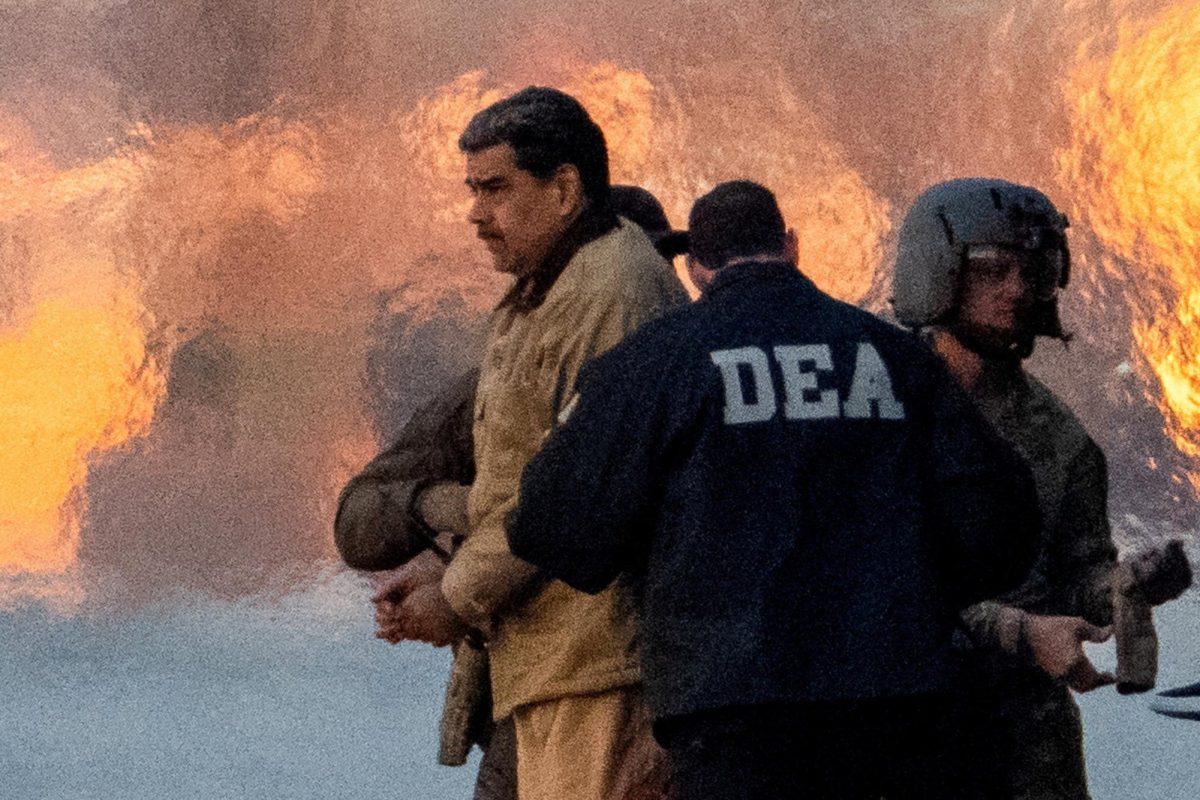
President of Venezuela Nicolás Maduro and his wife Cilia Flores were captured by the U.S. government in Caracas, Venezuela over the weekend of Jan. 3. He was accused of narco-terrorism by the Trump Administration after a months-long campaign to crack down on drug trafficking.
Delcy Rodriguez is currently the Acting President of Venezuela and has declared a 90-day state of emergency to give security forces more power to search and capture anyone who supports “the armed attack” by the U.S.. Maduro and Flores appeared in court in New York on Jan. 5 and pleaded not guilty. Maduro has previously claimed that these charges have been motivated by the U.S. government’s plans to gain further access to Venezuela’s oil reserves. Flores was charged with the same crime and with wielding her influence to harm the judicial system.
Venezuela holds about 303 billion barrels of crude oil reserves, a fifth of the world’s oil reserves. Trump recently filed an executive order to prevent the revenue of the Venezuelan oil held in the U.S. treasury from being taken, claiming that the revenue was only being held to maintain stability and safe guard American companies oil shares during Maduro’s absence.
Spanish teacher Andrew Suárez immigrated from Venezuela 30 years ago and lived through Maduro’s predecessor, Hugo Chávez’s military coup attempt in 1992.
“Well, I was initially ecstatic that he was doing it because Venezuela has been under this regime for 30 years,” Suárez said. “But I think the reason why he’s doing it is mainly for oil and money and not for the well-being or the human rights violations. It is for the money.”
Sophomore Ivan Hernandez immigrated from Venezuela four years ago, partly due to Maduro’s presidency. He found the capture of President Maduro to be a fortunate event.
“Capturing [Maduro] is actually a relief for [the Venezuelan community],” Hernandez said. “He was a dictator. He’s been in power for basically the past 27 years in Venezuela. He’s always been a part of the dictating party.”
Maduro has been a political leader since 2000 and became president in 2013. He has had a controversial political history: setting up a new constituent assembly with the power to write a new constitution and uproot opposing political parties to using excessive violence to restrain protests. Maduro also has accusations of detaining political rivals, rigging elections and packing the Supreme Tribunal of Justice. Flores was in the National Assembly from 2006 to 2011 and was Venezuela’s attorney general from 2012 to 2013.
Social Studies teacher Daniel Kosiba says this event might set a bad precedent for the future.
“No matter how bad a dictator is—and Maduro is a bad dictator—when one country decides that they have the right to go in and just remove people from office, that sets a dangerous precedent,” Kosiba said. “There’s historical precedent for this, and it almost always ends badly. When we see things like this manifesting, we’re on high alert.”