
Many students interviewed for this article did so on condition of anonymity for fear of consequences. The NWN agreed to use pseudonyms, indicated by an asterisk after the name.
Bathrooms are a place for people to handle their business, clean themselves up and be on their way. However, that business may not be what one would expect; here in bathrooms, one can be greeted with students exchanging flavors like blue razz, mint, strawberry banana and watermelon. Why? Students vape.
Students have been aware of these bathroom activities for a long time and an anonymous parent created a petition, “Enhance security to combat vaping at Niles West High School,” on Feb. 5. The petition raises concerns about vaping at school, including the use of THC and hallucinogens.
“Recently, it’s come to light that vaping has become rampant within the school’s premises,” the petition said. “The situation is alarming, not just because of the presence of nicotine, but due to reports of more dangerous substances like THC and hallucinogens.”
The petition calls for stronger security measures, staff accountability and educational programs to address the issue. As of May 13, the petition has 260 signatures.
Niles West News created an anonymous survey asking students about the issue. Out of the 387 responses, 3.1% admitted that they have vaped in school and 2.1% admitted they are addicted to nicotine. An anonymous student Sally James* vapes during school to cope with frustration and does not believe they are addicted.
“Sometimes teachers piss me off, and I just gotta go to the bathroom, get a good buzz [of nicotine] in, just come out and be happy,” James said. “I just do it when I’m mostly in school. I’m quitting after senior year ‘cause I feel like once you graduate, there’s no reason to be vaping.”
James shared that they mainly vape in their car but have also done it in the bathrooms, the locker room, at school sporting events and in classrooms by hiding the device in their sleeve.
91.1% of responses in the survey said they have seen someone vape at school. Another anonymous student, Jack Smith,* feels uncomfortable with the prevalence of vaping at school.
“It kind of makes me uncomfortable because you could have done it in your own time, but you’re surrounding me with it,” Smith said.
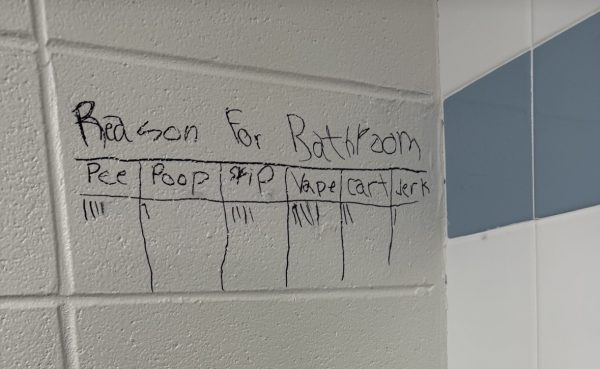
In an attempt to curb vaping, administrators closed off certain bathrooms beginning in Jan. 2026. Though these closures are no longer in effect, depending on the time of the day, students can still find some bathrooms locked. Senior Zeus Navalta was annoyed with the decision to close some bathrooms.
“It is very annoying when the bathrooms get closed up,” Navalta said. “When I had to go to the bathroom once, both bathrooms on the second floor were closed.”
In 2024, West installed vaping sensors for the first time. However, many students have found that these sensors are not effective in catching or preventing students from vaping.
“They don’t work because it still happens all the time and it took them long enough to put them in the first place,” anonymous student Frank Jacobs* said. “[Vaping] is standard in the school.”
Director of Security Al Lopez commented on the installation of vape sensors in bathrooms and their effectiveness.
“We did install vape sensors, we just have not found one that works to our standards,” Lopez said.
According to Lopez, safety team members check bathrooms throughout the day.
“The bathrooms are checked a minimum of twice a period and it is documented, they write down the times that they go in there,” Lopez said. “If they see an abnormally large amount of kids just hanging out and congregating, the safety team is encouraged to engage with the students and have them move along to where they need to move along.”
The petition mentioned concerns about safety team members at West vaping with students in the bathrooms. In the NWN survey, 14% of students reported that they have seen safety team members vaping on campus. Jacobs* recalls visiting the bathroom near the south lobby during the 2024-2025 school year and finding a large group of students vaping alongside a safety team member, who was also vaping.
“I walked into the bathroom by the south lobby, it was like there was a cloud [of vapor]… from how many people were in there,” Jacobs said. “There must have been like eight to ten people in there. They all had their own [vape] and there was even a security guard in there with them, smoking and talking to them.”
Lopez has been made aware of at least one claim against one safety team member and has not found any evidence of wrongdoing.
“It was been brought to my attention, we investigated, and we have found it completely baseless,” Lopez said.
Some students, like senior Hasan Hedayat, have become frustrated with the growing number of students vaping compared to what feels like a lower concern from staff.
“I kind of feel like it’s something that everyone knows is a problem, and it’s been a very underlying problem,” Hedayat said. “It’s treated like it’s a very low priority issue to the school board, and I’ve noticed from my freshman year that security guards are just choosing to ignore it and just kind of let them get off the hook. There are no consequences at Niles West, it feels like.”
District 219 previously ran the Student Assistant Program, SAP, which dedicated one staff member for Niles North and another for Niles West to assist students who have used cigarettes or illegal substances. This program included support groups and gave students alternative choices to restricted consequences. Counselor Ben Grais commented on the program, which is no longer running.
“We’ve usually had a social worker in charge of it,” Grais said. “That person would oversee any sort of drug, alcohol and teen smoking issues that came up and then provide necessary resources to support them, a lot of the time it was working in tandem with the deans. The dean would address it but they would also coordinate with the SAP person to make sure that the student was getting the support that they needed. Ultimately it’s not about discipline, it’s about solving the issue at hand and then providing the right resources to support the student.”
English teacher Dena Lichterman thinks the program should be reinstated.
“The district got rid of that a long time ago, which I think is problematic,” Lichterman said. “I do think it’s a position that should be brought back especially because students are saying that they are seeing other kids vaping. It was proactive but also worked as an intervention as well.”
When students are caught vaping or tell an adult that they are vaping in the building, the student’s support team, consisting of their counselor and psychologist or social worker, are involved to create a progressive disciplinary plan. While more aggressive disciplinary action can be taken, administration focuses on trying to seek positive alternatives for students vaping.
“If students are addicted, or they are experimenting, we want to address that and give them some education on what that is actually doing to their body,” Assistant Principal David Hawk said. “These are formative years, on physical growth, emotional growth, and for students that are engaging in these types of behaviors, we want to try to stop them as quickly as possible.”
In addition to in-school sources, the school may recommend outside organizations like PEER Services, an outpatient addiction treatment center in Evanston. This resource employs “holistic evidence based treatment” to teenagers and adults suffering from addiction, substance use and stigma.
Social worker Dominika Mueller shared how resources can help those suffering from addiction.
“I think taking a more preventative approach [and] raising awareness [works best],” Mueller said. “Finding ways to support students’ mental health and figure out what other strategies that they can use when they are stressed out so that they feel confident in those choices.”
Jacobs and the petitioner believe that more emphasis needs to be placed on safety team members to prevent students vaping in school.
“[Vaping] affects everyone, the people who do it are in every grade,” Jacobs said. “I think that… security guards should be put in pairs of seniority. I feel like that might help if one less experienced one is paired with another more experienced… strict one.”
According to the Center for Disease Control (CDC), about 1.63 million students (5.9%) vape. Students begin vaping for various reasons, but a common reason for many is peer pressure. 32.3% of teens who vape got their vape from a friend, and 21.7% were offered the product by someone else. Mueller commented on why many students begin to vape.
“In our conversations with [students caught vaping], I think it seems that students may try vaping and think ‘Oh it’s no big deal,’ or, ‘a friend introduced me to it,’ or ‘I only do it socially or maybe just when I was stressed,” Mueller said. “They don’t often think about the long term consequences… how addictive it is, how expensive it is, [and] all of the consequences on their health.”
An anonymous student Jane Williams* was one of those teens who was surrounded by vaping and pressured into it.
“I was surrounded by a lot of people that were doing it and over time I started to do it without even realizing,” Williams said. “As soon as I realized I was doing it often I just threw it out and haven’t done it since.”
Smith shared that though they have not vaped, they have thought of it before.
“I’ve thought of it, but I’ve never actually done it. You just see a lot of people do it, it just kind of influences your brain,” Smith said.
Nicotine, which is often found in vapes, is highly addictive. According to the CDC, nicotine is uniquely dangerous to young people because their brains are still developing until the age of 25. The compound can affect mood, attention, learning and impulse control. Vapes can also contain a plethora of chemicals that are cancer causing and that are heavy metals like nickel, tin and lead.
Social studies teacher Matthew Wiemer believes that teenagers are not thinking about the long-term consequences of vaping.
“I don’t think that young people understand what the long term effects of vaping might do to their bodies and I don’t know that science knows the long term effects of what vaping might do to their bodies yet, so I think it’s incredibly dangerous,” Wiemer said. “I think all high schools are facing problems with it, I don’t think our high school is any different from any other place.”
On May 5, the Food and Drug Administration (FDA) announced its approval of fruit flavor e-cigarettes created by Glas Inc. that are to be marketed as Gold, Sapphire, Classic Menthol and Fresh Menthol. The flavors underlying them are mango, blueberry, and menthol.
While this product is like any other e-cigarette, youth have historically been attracted to vapes that are fruit flavored. According to Campaign for Tobacco-Free Kids, a nonprofit advocacy organization working to reduce tobacco use, the vast majority of underage users prefer flavored vape products.
“Nearly 90% of youth e-cigarette users use flavored products, with fruit, candy/desserts/other sweets, mint and menthol reported as the most popular flavors,” the site says.
According to the FDA, Glas will use a technology to verify the user’s age. Once verification is achieved, the device will operate without a Bluetooth paired phone. In addition the device is supposed to use random biometric checks to confirm that the user is verified. The FDA will monitor the company to ensure that it is in compliance with current regulations.
Quitting doesn’t have to start at school. Students can call the hotline 1-800-QUIT-NOW or 1-800-784-8669 for support or to create personalized plans to quit.