

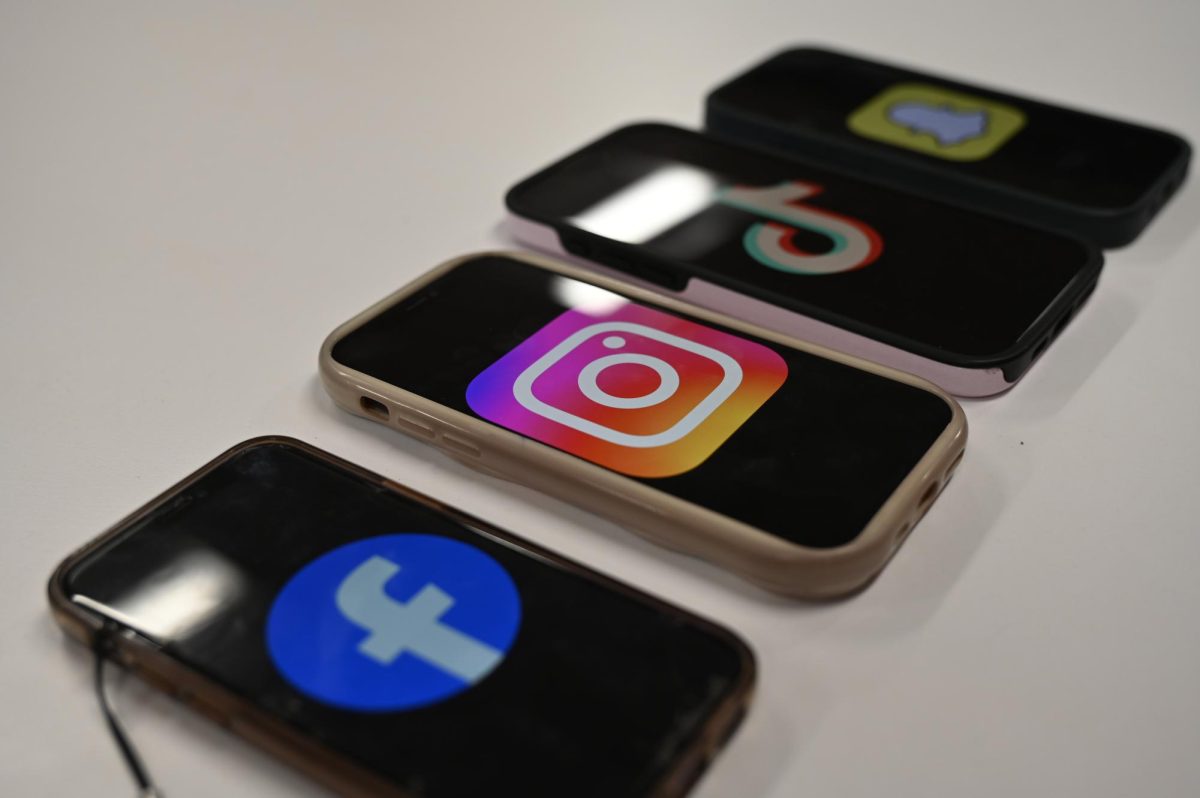
Everywhere you look at school, whether in the hallway, cafeteria or in class, someone is staring at a screen. Phones are always in hand, and AirPods are always in use. For most students, checking their phone has become nearly automatic. At this point, screen time isn’t just about entertainment anymore. It has turned into a daily habit.
Teachers have been able to see firsthand how technology has affected students in their classrooms. The implementation of phone caddies aims to reduce distractions and help keep students focused during class. However, with the increased use of technology, students have gotten in the habit of watching shorter videos on social media apps like Tiktok, which makes it harder for students to focus on things for a longer period. English teacher Ainee Fatima finds that it has become harder to keep students engaged while watching a full-length movie in class.
“When I was in school, we would get so excited because we could just sit and watch,” Fatima said. “This generation is so used to short TikToks and short YouTube videos that movies seem boring now, and I don’t know how to get them to pay attention to watch one.”
Although school policies aim to limit phone use during class, the real challenge often comes down to self-control. Some students say that the temptation is hard to ignore, even when they want to focus. Senior Sayan Khan does not enjoy the phone caddies yet finds it hard to resist the urge to pick up his phone.

“I have to throw my phone across the whole room because it’s so tempting to pick up, but usually I’m good about it,” Khan said.
Other students, like senior Amal Fazil, find it easier to abstain from using her phone when studying if it’s getting in the way.
“I try to stay off my phone for a little bit,” Fazil said. “I do, like, 30 minutes on work, then 10-minute break on my phone and 30 more minutes back to my homework.”
As technology becomes more integrated into daily life, it becomes harder to resist the constant pull of a screen. Even outside of school, it’s common to see people scrolling through their phones while walking, eating or spending time with friends. Since phones are such a normal part of everyday routines, asking students to put them away for an entire class period can feel like a challenge. Still, Fatima believes that the balance of technology usage is the key.
“I think that they can survive without it for 45 minutes, but I have days where they’re allowed to have it and use it to listen to music. So I think in moderation, it is good,” Fatima said.
Legal actions have increasingly highlighted the impact of social media on adolescence, especially regarding the continuous growth of addiction and mental health. Constant screen exposure affects a student’s everyday life. The Student Services Department has raised questions about the emotional and behavioral impact of constant screen exposure to students at Niles West. Specifically, Social Worker Dominika Mueller shares the harms of using social media for a student’s mental health.
“Sometimes there are things that we might follow on social media that can be very heavy with what goes on in the world today, too, and so just being mindful of the type of information that you’re constantly consuming and how that impacts your mood and your energy,” Mueller said. “I think we could be prone to comparing ourselves to others on social media, which can really impact our mental health and make us feel even more isolated.”
Mueller further elaborates on the impact of academic performance on a student’s behavior. The constant exposure to blue light during nighttime can cause sleep deprivation and fatigue. Lack of good sleep then heavily impacts a student’s performance for the rest of the day. To combat these problems, Mueller emphasizes intervention strategies, self-awareness and setting boundaries when it comes to using phones.
“I think just encouraging students to just be aware of [screen-time], implementing a cutoff time at night [and] put my phone on airplane mode or hit do not disturb,’’ Mueller said. “Thinking about having boundaries with others where you don’t always have to feel a need to pick up or respond to that text right away because that could be overwhelming too.”










Jeff Meyers • Apr 9, 2026 at 4:01 PM
bro i hate brainrot